

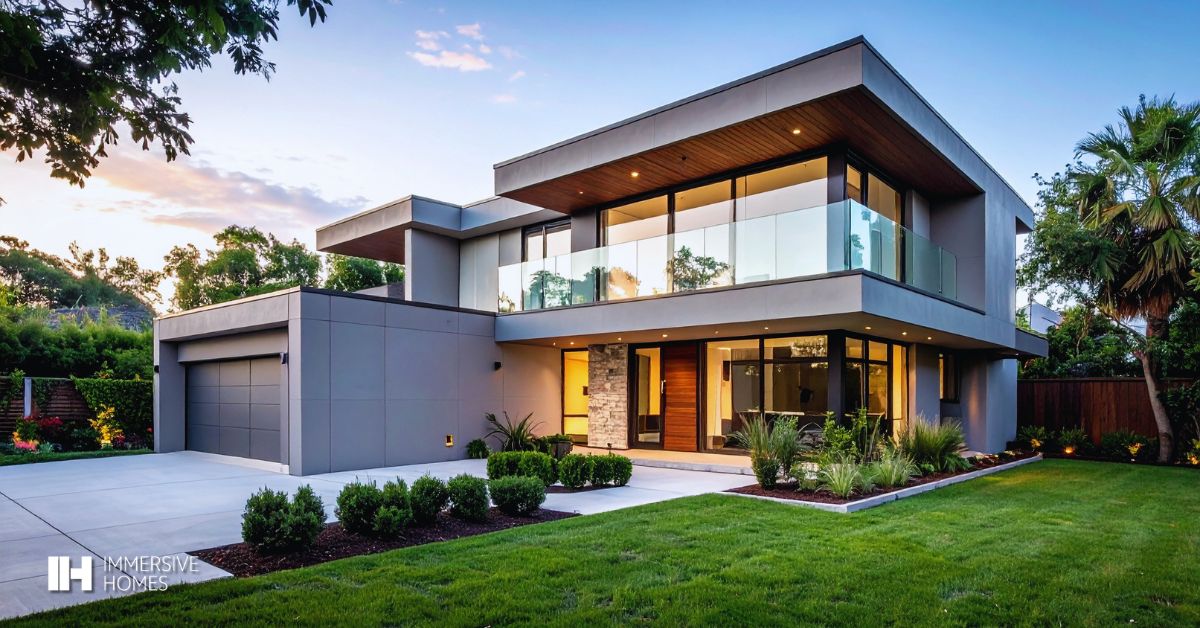
What Are the Main Characteristics of a Modern House?
A modern house is defined by clean geometry, open interior layouts, large windows, minimal ornamentation, and a deliberate use of natural and industrial materials. These traits work together to create homes that feel spacious, functional, and visually calm.
The core characteristics include:
- Flat or low-pitched rooflines
- Open floor plans with few interior walls
- Large, floor-to-ceiling or clerestory windows
- Exterior materials like concrete, steel, wood, and glass used together
- Minimal trim and ornamentation on both interior and exterior
- Strong connection between indoor living areas and outdoor spaces
- Integration of energy-efficient systems from the start of the design
Modern design is not a trend. It is a building philosophy rooted in function, material honesty, and the elimination of anything that does not serve a purpose.
1. Clean Lines and Simple Forms
Modern homes avoid decorative flourishes. Rooflines are flat or gently sloped. Facades are composed of rectangular forms arranged with deliberate proportion. This simplicity is not a lack of detail — it is a disciplined approach to form that ages well and costs less to maintain.
2. Open, Connected Floor Plans
Where traditional homes divide space into separate rooms with distinct purposes, modern homes favor open, flowing layouts. The kitchen, dining area, and living room are typically combined into a single space. This makes the home feel larger than its square footage suggests, improves natural light distribution, and aligns with how most families actually live today.
3. Large Windows and Natural Light
Windows in modern homes are not an afterthought. They are a structural and design element. Floor-to-ceiling glass, ribbon windows, and clerestory placements are chosen based on orientation to daylight, views, and passive solar gain. The result is an interior that feels connected to the outside without sacrificing privacy or energy performance.
4. Mixed Materials on the Exterior
A modern home exterior typically combines two or three materials — often wood or wood-look cladding alongside concrete, metal panel, or fiber cement. The contrast between warm and cool materials gives modern homes their signature visual texture without relying on decorative detail.
5. Minimalist Interior Details
Inside, modern homes use flat-panel cabinetry, handle-free hardware, flush baseboards, and smooth wall finishes. The goal is surfaces that are easy to clean, visually quiet, and long-lasting. Color palettes lean neutral — whites, grays, warm taupes — with contrast introduced through furniture and natural materials.
What Makes a Modern Home Look Different From a Traditional Home?
The difference is visible from the street and felt the moment you walk inside.
1. Roofline and Facade Differences
Traditional homes feature steep-pitched roofs, gabled dormers, decorative shutters, and symmetrical window arrangements. Modern homes use low or flat rooflines, asymmetrical compositions, and horizontal emphasis. Where a traditional home draws your eye upward, a modern home draws it across.
2. Interior Trim and Finish Differences
Traditional interiors use crown molding, raised-panel doors, ornate cabinetry hardware, and layered millwork. Modern interiors eliminate most of this. Door casings are thin or absent. Ceilings are clean. The craftsmanship in a modern home is in the precision of the joints and the quality of the materials, not in the volume of decoration.
3. How Outdoor Space Is Used
Traditional homes treat the yard as separate from the house. Modern homes blur that line. Covered patios, large sliding or folding glass doors, and continuous flooring materials that run from inside to outside are standard in modern custom design. Outdoor living is not an addition — it is part of the original floor plan.
What Are the Benefits of Building a Modern Custom Home?
The most common hesitation buyers have about modern design comes down to three questions. Here are honest answers to each.
Does a Modern Home Actually Save Money Over Time?
Yes, in most cases. Modern homes are designed with energy performance as a core requirement, not an upgrade. High-performance windows, continuous insulation, air-sealing, and efficient HVAC systems reduce monthly utility costs from the first year of occupancy.
The simpler roofline and exterior also mean fewer maintenance points compared to a traditional home with complex trim and multiple roof planes. Resale value for modern custom homes in Michigan has remained strong, particularly as more buyers prioritize energy performance and flexible living layouts.
Will a Custom Modern Home Fit My Lifestyle?
Modern design is among the most adaptable residential styles available. Open floor plans are easy to reconfigure for remote work, multigenerational living, or changing family needs. Rooms are defined by furniture arrangement and lighting rather than fixed walls, which gives you flexibility that traditional layouts cannot match.
Aging-in-place design integrates naturally into modern homes because wide doorways, single-level layouts, and curbless showers are already part of the design language—not bolted-on modifications later.
Is Modern Design Too Cold or Impersonal?
This is the most common objection and is worth addressing directly. A poorly executed modern home can feel sterile. A well-designed one feels calm, warm, and livable. The difference is in the material choices.
White oak floors, exposed wood ceiling beams, natural stone, linen textiles, and warm-toned lighting all bring warmth into a modern interior without compromising the design principles. Immersive Homes approaches every project with livability as the primary brief, not aesthetics alone.
What Features and Components Define a Modern Custom Home?
Structural and Exterior Features
- Flat or shed rooflines with internal drainage
- Cantilevered sections and clean overhangs for shade
- Horizontal board, metal panel, or concrete fiber cladding
- Attached or integrated garage with flush facade treatment
- Minimal landscaping with hardscape elements that complement the architecture
Interior Layout and Flow
- Open-concept kitchen, dining, and living zones
- Primary suite positioned for privacy and natural light
- Dedicated home office or flex room built into the original plan
- Mud entry and utility zones concealed from main living areas
- Storage is integrated into walls and under stairs to maintain clean surfaces
Smart Home and Energy Systems
- Pre-wired for whole-home automation (lighting, security, climate)
- High-efficiency heat pump or geothermal HVAC
- ERV or HRV ventilation for indoor air quality
- Solar-ready roof and electrical panel
- EV charging in the garage as standard, not optional
Windows, Doors, and Natural Light Design
- Triple-pane or high-performance double-pane units
- South-facing glass maximized for passive solar gain in Michigan's climate
- Exterior shading via overhangs calculated for summer sun angles
- Sliding or folding patio door systems for indoor-outdoor connection
How Much Does It Cost to Build a Modern Home in Michigan?
Pricing a custom home accurately requires a site visit, a design brief, and a detailed scope. That said, here is an honest framework for what shapes the cost.
What Drives the Cost of a Modern Custom Home?
The biggest cost variables in a modern custom home are:
- Square footage and layout complexity: Open plans with large spans require engineered lumber or steel, which costs more than standard framing
- Window and door specifications: High-performance glazing is a meaningful line item, but it pays back in energy savings and comfort
- Exterior material selections: Metal panel and architectural concrete cost more than vinyl or standard fiber cement
- Site conditions: Michigan lots vary significantly in soil bearing capacity, slope, and utility access
- Finish level: Modern homes can be built at a range of finish levels — the design language does not require premium materials throughout
Where Can You Control Costs Without Sacrificing Design?
The proportions and lines of a modern home are what make it feel modern — not the price of the countertop. Smart buyers invest in the building envelope, windows, and structural elements first, then make selections on finishes based on remaining budget. Immersive Homes walks every client through this prioritization early in the process so there are no surprises at the finish selection stage.
What Does the Investment Look Like Over 10 Years?
A modern custom home built to current energy performance standards costs less to operate than a code-minimum home of the same size. Lower utility bills, fewer maintenance cycles on simplified exteriors, and strong resale demand from a growing buyer pool who prioritize modern design all contribute to long-term value. The upfront investment is higher than for a production home. The 10-year picture typically looks different.
Why Choose Immersive Homes for Your Modern Custom Home in Michigan?
Experience Building Modern Custom Homes in Michigan
Immersive Homes has spent years designing and building custom homes across Michigan. We understand the climate demands, the permitting landscape, the available materials, and the subcontractors who do precise work at the level modern design requires.
How We Approach Design and Craftsmanship
We do not separate design from construction. The same team that develops your plans manages your build. This eliminates the communication gap between the architect and builder, which is one of the most common sources of cost overruns and design compromises in custom home construction. Every home we build is designed for the specific site, the specific family, and the specific budget — not adapted from a previous project.
What Should You Look for in a Modern Custom Home Builder?
Not every builder who says they build modern homes has the experience to execute the details that make modern design work. Here is what to evaluate.
Questions to Ask Before You Sign
- How many modern custom homes have you completed in the last three years?
- Can I speak with past clients and visit completed projects?
- Do you handle design in-house or do you work with a separate architect?
- How do you manage the gap between design intent and construction execution?
- What is your process when site conditions or material availability changes the plan?
Red Flags to Watch for in Any Builder
- Portfolios that show only renderings, not completed homes
- Reluctance to provide client references
- Separate design and build contracts with no clear coordination process
- Vague answers about subcontractor selection and oversight
- No discussion of energy performance or building science in the design process
How Immersive Homes Meets These Standards
We welcome site visits to completed homes. We provide client references at the first consultation. Our design and build process is managed under one roof. And we discuss energy performance before we discuss finishes, because the envelope decision made at the start of a project cannot be corrected at the end.
Modern House Characteristics and What They Mean for Your Custom Build in Michigan
A modern house is defined by clean lines, open layouts, high-performance windows, mixed exterior materials, and a commitment to function over decoration. These characteristics are not just aesthetic choices — they shape how the home performs, how it feels to live in, and how it holds value over time.
For Michigan homebuyers who want a home built around how they actually live, modern custom design offers a level of flexibility and long-term performance that production homes and traditional custom builds rarely match.
Immersive Homes builds modern custom homes across Michigan with a process designed to eliminate surprises and deliver homes that work as well as they look.