

Is Building a Custom Home More Expensive Than Buying Existing?
It can cost more upfront, but the comparison is not straightforward. When you buy an existing home, you often inherit layouts you did not choose, systems that are aging, and a list of renovations you plan to tackle later. Those renovations add up.
A custom home built on a solid house construction plan gives you a structure designed for how you actually live, built with materials you selected, and backed by a new construction warranty.
Over a 10- to 20-year horizon, many Michigan homeowners find that the total cost of ownership is comparable to or lower than buying and renovating.
Is the Process Too Complicated to Manage?
It does not have to be. The process feels complicated when a homeowner is expected to coordinate architects, engineers, permit offices, subcontractors, and suppliers on their own.
That is not how Immersive Homes works. We manage the coordination. You make the decisions. We handle the execution.
How Long Will I Actually Be Without a Home?
A realistic custom home timeline in Michigan runs between 10 and 18 months from design approval to move-in, depending on size, complexity, and permit processing times. We give every client a written project schedule at the start to avoid surprises.
Many clients plan around this timeline by locking in a lease extension or timing a sale accordingly. We help you plan that too.
What Does a House Construction Plan Include?
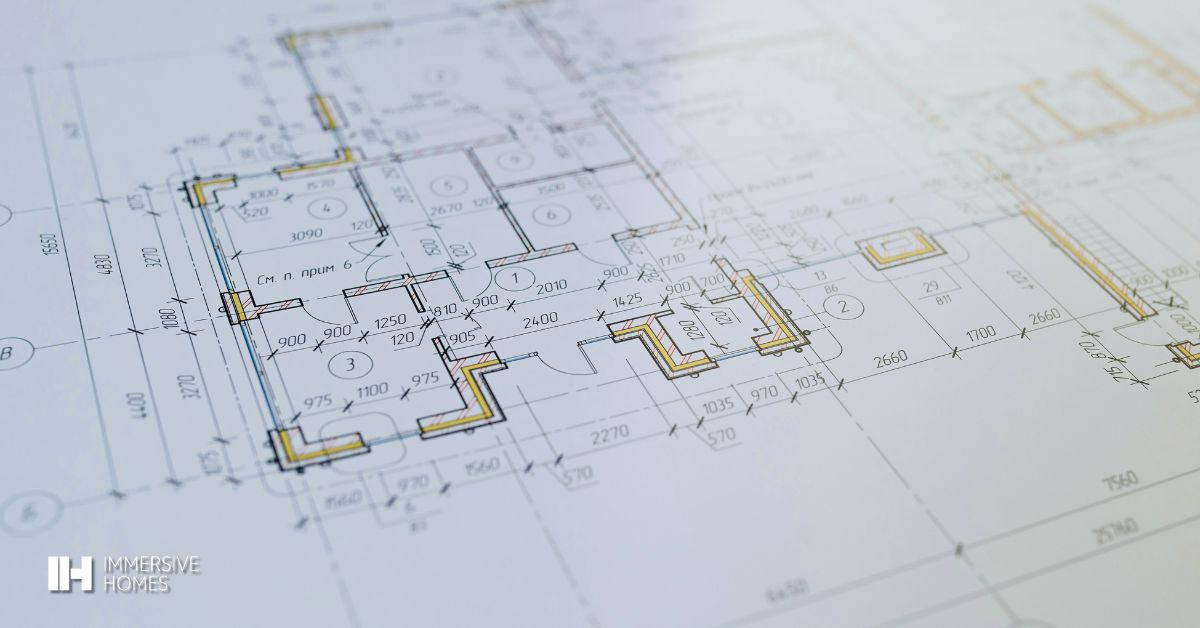
A house construction plan is not a single document. It is a coordinated package of drawings, specifications, and schedules that tells everyone on the job site exactly what to build, where to build it, and what materials to use.
Here is what a complete plan contains.
1. Site Plan and Land Assessment
The site plan shows how your home sits on your lot. It documents setbacks, utility connections, drainage direction, driveway placement, and grading. This document is required for permitting in Michigan and must reflect your specific parcel.
Before design begins, Immersive Homes reviews your land for slope, soil conditions, flood zone status, and access — factors that directly affect your foundation type and site preparation cost.
2. Architectural Drawings and Floor Plans
Architectural drawings include your floor plan layout, exterior elevations, roof plan, and cross-section views. These show the room dimensions, window and door locations, ceiling heights, and the home's orientation on the site.
At the schematic stage, drawings are used for client approval. At the construction document stage, they are detailed enough for your builder and permit office to act on.
Floor plans show square footage and room relationships. Construction drawings show how those rooms are built — wall assemblies, structural headers, stair configurations, and more.
3. Structural and Mechanical Specifications
These documents define how your home holds together and functions day to day. Structural specs cover foundation type, framing system, beam and header sizing, and load calculations. Mechanical specs cover HVAC system design, plumbing rough-in locations, and electrical panel layout.
Michigan's building code requires these specifications to be submitted with your permit application. Having them prepared the first time correctly avoids revision requests that delay your start date.
4. Material and Finish Schedules
A material and finish schedule is a line-by-line record of every selection in your home — roofing, siding, windows, flooring, cabinetry, countertops, fixtures, and hardware. This document ties your design choices to your budget and serves as your builder's purchasing guide.
When a product is out of stock or discontinued, the schedule makes it easy to identify an approved substitute without a design meeting.
What does a house construction plan include?
A house construction plan includes a site plan, architectural drawings, floor plans, structural specifications, mechanical specifications, and a material and finish schedule. Together these documents tell every person on the job site exactly what to build, where to build it, and what materials to use.
What is the difference between a floor plan and a construction plan?
A floor plan shows room layout, square footage, and how spaces relate to each other. A full construction plan goes further and includes structural details, mechanical systems, exterior elevations, and the specifications a builder and permit office need to act on.
Do I need a site plan to get a building permit in Michigan?
Yes, Michigan municipalities require a site plan as part of your permit application. It must show your home's placement on the specific parcel, including setbacks, grading, utility connections, and driveway location.
How Much Does a House Construction Plan Cost in Michigan?
Cost is the question most homeowners ask first and get the least useful answers to online. Here is a straightforward breakdown.
Several factors determine where your project lands on the cost spectrum:
- Square footage: Larger homes require more drawings, more specifications, and more coordination
- Design complexity: Open floor plans with standard rooflines cost less to design and build than homes with multiple roof pitches, large spans, or custom structural elements
- Site conditions: Steep slopes, high water tables, or poor soil bearing capacity add engineering cost and foundation expense
- Finish level: Entry-level finishes, mid-range selections, and luxury specifications each carry different material and labor costs
- Location within Michigan: Labor rates vary between rural counties and metro areas like Grand Rapids, Ann Arbor, and Detroit
How Does the Custom Home Construction Process Work?
Here is how Immersive Homes takes your project from an idea to a finished home.
Step 1: Discovery and Site Evaluation
We start with a conversation. We want to understand how you live, what you need from your home, and what your budget looks like.
We also review your land — or help you evaluate a parcel you are considering — to identify any site conditions that will affect design or cost. This step is optional and free.
Step 2: Design and House Construction Plan Development
Once we agree on scope and budget, our design team begins your house construction plan. We start with schematic floor plans and exterior concepts for your review.
After your approval, we develop full construction documents including architectural drawings, structural engineering, and mechanical specifications. You review and approve the plan before it goes anywhere.
Step 3: Permits and Pre-Construction
We submit your house construction plan to the appropriate Michigan municipality and manage the permit process on your behalf. Michigan permit timelines vary by county and project complexity, but we factor this into your schedule from day one.
During this phase, we also finalize subcontractor agreements and lock in material orders to protect against supply delays.
Step 4: Construction and Regular Communication
Construction begins after permit approval. Your project has a dedicated project manager who sends you weekly written updates, flags any decisions that need your input, and keeps the schedule on track.
You have direct access to your project manager by phone and email throughout the build. Site visits are welcome and encouraged at scheduled milestones.
Step 5: Final Walkthrough and Handover
Before you take possession, we walk the home with you, room by room. Any items on the punch list are completed before closing. You receive a full documentation package including your house construction plan, permit records, material warranties, appliance manuals, and your Immersive Homes warranty terms.
You move in knowing exactly what you have and what is covered.
What are the steps in the custom home construction process?
The custom home construction process follows five steps: discovery and site evaluation, house construction plan development, permits and pre-construction, construction, and final walkthrough and handover. Each phase builds on the last, with client approvals at key points before work advances.
How does the custom home design process start?
The process starts with a discovery conversation where your builder learns how you live, what you need, and what your budget looks like. If you already own land, your builder will also review the site for conditions that could affect your design or cost.
Who manages the permit process when building a custom home in Michigan?
At Immersive Homes, the design-build team submits your house construction plan to the appropriate Michigan municipality and manages the permit process on your behalf. Permit timelines vary by county, but the schedule accounts for this from day one so your overall timeline is not disrupted.
Why Trust Immersive Homes With Your House Construction Plan?
Immersive Homes has delivered custom home projects across Michigan, including the Grand Rapids metro, Traverse City, Kalamazoo, and the greater Detroit area. Our portfolio includes single-story ranch designs, two-story family homes, lakefront properties, and energy-efficient builds that meet Michigan's cold-climate performance standards.
Immersive Homes holds a Michigan Residential Builder License in good standing with the Michigan Department of Licensing and Regulatory Affairs (LARA). Our team carries full general liability insurance and builder's risk coverage on every active project. We are members of the Home Builders Association of Michigan and follow the Michigan Residential Code on all projects.
Ready to Start Your House Construction Plan in Michigan?
You have done the research. You know what a custom home build involves and what to look for in a builder. The next step is a conversation with our team — no pressure, no commitment, just a straight conversation about your project and whether we are the right fit.
Here is what happens after you submit the form:
- A member of the Immersive Homes team contacts you within one business day
- We schedule a 30-minute discovery call to understand your goals, land situation, and timeline
- If it makes sense to move forward, we provide a no-obligation project estimate
Immersive Homes serves custom home clients across Michigan. We are licensed, insured, and ready to build.