

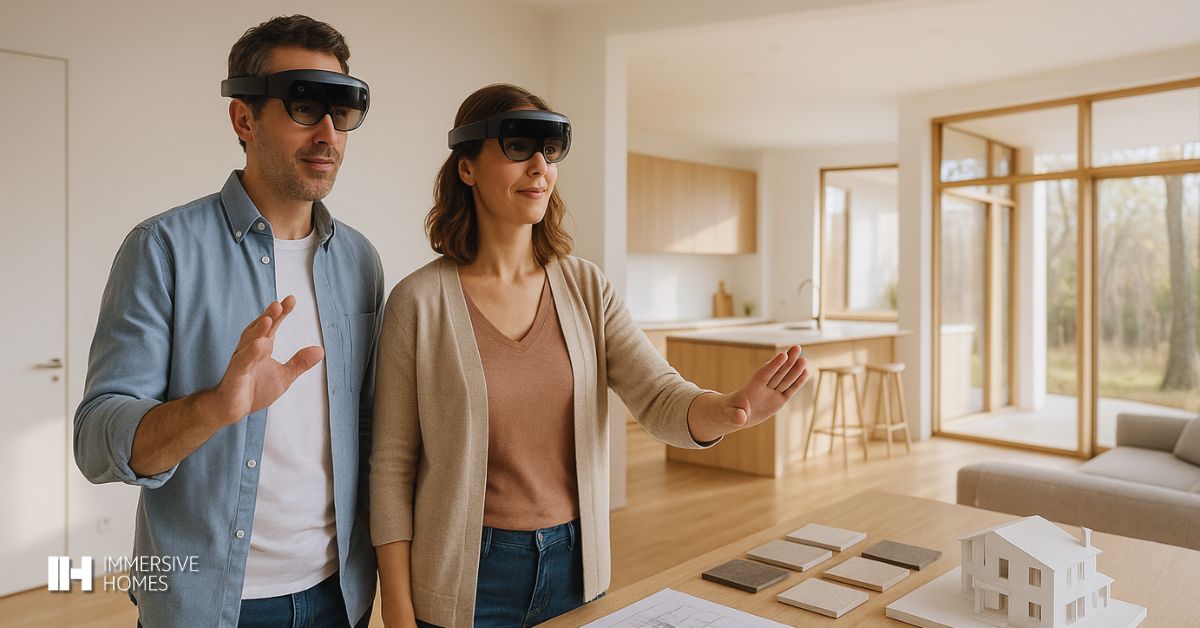
Almost every homeowner who sits down with us arrives carrying the same thing: a house that already exists, fully furnished, in their head. They know where the morning light should land. They know the ceiling should feel tall without feeling cold. They know the view from the kitchen sink matters more than the size of the guest room.
What they don't have is confidence that anyone will build it the way they see it.
That worry is earned. Traditional construction passes your vision through a relay of separate hands: an architect, an engineer, a supplier, a framing crew, a string of subcontractors. Every handoff is a chance for something to slip. Most people have heard the stories or lived one. The change order that blew the budget. The schedule that slid a full season. The great room that somehow feels smaller than the drawings promised.
Virtual reality is the first tool in this industry to directly address that worry. Not by promising more, but by showing more. In this guide, we'll walk through where immersive technology stands in 2026, what the research does and doesn't prove, where regulators are drawing new lines, and why we believe the biggest payoff isn't in selling existing homes at all. It's in building new ones that finally match what you imagined.
What Is Virtual Reality in Real Estate Marketing?
Virtual reality in real estate marketing is the use of immersive 3D technology to let someone experience a property, whether it's standing today or still on the drawing board, as if they were inside it. The term gets used loosely, so it helps to know what you're actually looking at.
The simplest form is the 360° photo tour, where you turn your head from fixed spots in each room. It works on any phone or laptop, which makes it a good fit for rentals and budget listings. A step up is the 3D walkthrough, often called a digital twin, which lets you move freely through a scanned model of the property and switch to a cutaway "dollhouse" view. It also runs on a phone or laptop, with a headset as an option, and it's most useful for reselling homes and commercial spaces.
Headset VR is where things change. Wearing a VR or mixed reality headset, you stand in the space at full scale and sense its height and proportion with your body, which is why it matters most for custom homes, new construction, and pre-sales. Augmented reality takes a different approach, layering digital furniture or finishes over whatever your phone, tablet, or headset camera sees, so it's ideal for renovation and finish decisions. Finally, aerial 3D built with Gaussian splatting lets you fly around a home and its land from any angle on an ordinary screen, a big advantage for acreage, rural lots, and properties where the view is the selling point.
Here's something that surprises people: the vast majority of immersive real estate content is viewed on an ordinary screen. That's why it scaled. Matterport alone had digitized more than 14 million spaces by the time it was acquired in 2025.
Headset VR does a different job. It isn't really for browsing. It's for judgment. Does that vaulted ceiling feel generous or cavernous? Is the hallway a little tight? Would turning the house ten degrees put the sunset in the primary suite instead of the garage? Those are questions a floor plan can't answer, and they're the ones that decide whether a home feels right for the next thirty years. We go deeper on this in how 3D real estate models help buyers understand every detail before building.
How Has Real Estate Marketing Changed Because of Virtual Reality?
Real estate marketing has shifted from describing a property to letting buyers explore it on their own terms. That shift happened slowly for years, then almost overnight.
For most of the industry's history, the agent controlled the story. You saw the photos they chose, walked the route they planned, and filled in the rest with imagination. Video and drone footage added motion, but you were still watching someone else's tour.
Affordable 3D capture changed that by handing the controls to the buyer. Then 2020 poured fuel on it. Among buyers surveyed for NAR's 2020 profile, 27% used virtual tours after March, compared with 16% before. What began as a pandemic workaround quietly became an expectation.
The years since have made that expectation permanent. In 2025, CoStar completed its $1.6 billion acquisition of Matterport, pulling 3D digital twins into a major listings marketplace. That same year, two major U.S. listing portals rolled out aerial 3D exterior tours built on Gaussian splatting, one in July and one in October. By 2026, the technology had grown influential enough to draw regulation: California's AB 723 now requires disclosure of digitally altered listing images.
The bigger change is emotional. Buyers used to hand over control and hope the showing matched the photos. Now, many arrive having already walked the floor plan three times on their phones at midnight. The agent's role has moved from gatekeeper to guide.
For people building rather than buying, the shift goes further still. When you can see your home's layout before construction starts, marketing and design stop being two separate conversations. They become one.
How Are Real Estate Professionals and Builders Using VR Today?
Today, VR shows up at nearly every stage of the journey, from the first scroll through listings to the final sign-off on a custom home. Some uses are about convenience. The most meaningful ones are about peace of mind.
- Tours that do the filtering for you. A 3D walkthrough lets buyers explore at their own pace and come back after a showing to settle a debate about the kitchen. For sellers and agents, it quietly screens out people who were never going to buy, so the showings that do happen are with serious buyers.
- Virtual staging. Empty rooms are hard to read. Virtual staging adds furniture so buyers can grasp scale and flow, at a fraction of the cost of physical staging. It now comes with disclosure obligations in some states, which we'll get to. If you're shopping, our guide to virtual home tours and virtual staging explains how to read these images with a clear eye.
- Selling homes before they exist. Developers use VR to pre-sell homes that are still drawings, letting buyers walk through rooms and test finishes months before construction.
- Designing a custom home on your own land. This is where the technology stops being a marketing feature and becomes something personal. In our VR design sessions, homeowners step into their future home oriented on their actual site. You see what the living room window frames at 7 a.m. You feel whether the island leaves enough room when the whole family is in the kitchen. You make changes while they cost nothing. If you're curious what that's like, here's what to expect from your first virtual home design session.
- Buyers who can't be there in person. Relocating families, out-of-state buyers, and investors can narrow a shortlist without booking a single flight.
- A bridge between agents and builders. Sometimes the right resale home just isn't on the market. More agents are bringing those clients to builders who design immersively, and our Realtor Program was created for exactly that handoff. We've also shared ideas on how agents can grow their business by offering custom home options.
What Are the Benefits of VR for Buyers, Sellers, Agents, and Builders?
The core benefit of VR is simple: it replaces imagination with experience. That saves everyone time, and it spares the person writing the check a great deal of regret.
- Buyers vet homes before they visit. Instead of spending weekends driving between showings, buyers can walk through homes from their couch and arrive at open houses with a sharper, shorter list.
- Sellers keep the home "open" around the clock. A virtual tour never closes, which means out-of-area buyers can engage seriously without ever booking travel.
- Agents make their listings stand apart. Immersive tours strengthen listing presentations and attract better-qualified leads, because buyers who reach out have already seen the home in detail.
- Builders and developers get designs approved earlier and more clearly. When clients can see exactly what they're signing off on, there are fewer late changes, which protects both schedules and margins.
- Homeowners building custom see the finished home before committing to it. The vision, the budget, and the timeline stay intact because surprises are caught while they still cost nothing to fix.
That last group is where the stakes are highest. If a resale buyer misjudges a room, they repaint or rearrange. If a family building from scratch misjudges a ceiling height or a window placement, they live with it for decades.
It's the reason we built our entire process around immersion. At Immersive Homes, architecture, engineering, fabrication, and on-site assembly all work from one digital thread. The home you approve in VR is the same model our factory uses to fabricate your steel frame, held to 1/16-inch tolerances. Nothing gets retyped, redrawn, or reinterpreted by a stranger along the way. If you're weighing materials, too, our explainer on why steel-frame homes are a better choice follows the same logic of precision.
For first-time buyers, the benefit is often more personal than practical: less anxiety. We explored how VR home tours reduce stress for first-time buyers.
Do Virtual Tours Actually Help Sell Homes Faster?
Virtual tours clearly help buyers make better decisions, but the evidence that they shorten time on market on their own is thinner than many marketing claims suggest. We'd rather be straight with you: they're a powerful supporting tool, not a magic switch.
Start with what buyers say. In the National Association of REALTORS® 2025 Home Buyers and Sellers Generational Trends Report, 41% of buyers who searched online rated virtual tours "very useful," while 83% rated photos the same. Agents see the same pecking order. In NAR's 2025 Profile of Home Staging, buyers' agents ranked photos (73%) ahead of physical staging (57%), video (48%), and virtual tours (43%) as important to their clients.
That same staging report holds the number we find most telling: 83% of buyers' agents said staging made it easier for buyers to picture a property as their future home. Visualization is the real currency. Not novelty, not gadgets. The ability to see yourself living there is what moves people to act.
So for existing homes, tours earn their place by helping buyers decide faster and by sending more committed people through the door. Most people buying a home to live in will still want to walk it before closing, and they should.
Where VR delivers its clearest financial return is earlier, in construction. Research from PlanGrid and FMI found that miscommunication and poor project data account for 48% of all rework on U.S. construction sites, an estimated $31.3 billion a year at the time of the 2018 study. Every misunderstanding a homeowner catches while standing inside a VR model never turns into a change order, a delay, or a quiet disappointment at move-in. That's the heart of how home visualization helps you avoid expensive mistakes.
How Are AI and VR Converging in Real Estate Marketing?
AI is making immersive content faster to produce, cheaper to deliver, and far more lifelike, which is turning VR from a premium extra into basic infrastructure.
You can see it in how scenes are built. Gaussian splatting, the technique behind the new aerial home tours, represents a space with millions of tiny colored ellipsoids instead of a mesh of flat triangles. The result renders smoothly on a phone and handles organic detail like trees and terrain in a way older 3D models never could. You can see it in the deal-making, too. When CoStar closed its Matterport acquisition, its leadership pointed specifically to AI-powered property insights as part of the value.
For custom homebuilding, the convergence matters even more. AI can help explore layout options based on how you actually live. VR lets you feel the result. And when that same model flows straight into engineering and fabrication, you have what the industry calls a digital twin: one source of truth that follows your home from the first sketch to the last bolt. No reinterpretation. No lost details between offices.
That single digital thread is how we keep what you imagined intact. We've written more about it in how digital twins make building a home more predictable and transparent and how AI home design tools help you create a home that fits your life.
VR Is Really About Certainty
So, how is real estate marketing evolving with virtual reality? It's moving from persuasion to proof. People no longer want to be told a home is bright, open, and thoughtfully designed. They want to stand in it, turn around, and decide for themselves.
For resale homes, that means honest, well-disclosed immersive tours that help the right buyer find the right house. For new construction, it means something bigger: the chance to see your finished home, on your own land, before anything is built, and to trust that what you approved is exactly what arrives.
That's the promise Immersive Homes was built on. We brought architecture, engineering, fabrication, and on-site assembly under one roof and onto a single digital thread, so your vision never gets passed among strangers. Your steel-framed home is precision-manufactured in our own factory, with light-filled, wide-open spaces designed around your site. Most of our homes go from contract to move-in ready in under 12 months. Predictable timelines. Transparent pricing. A finished home that feels like the one you've been picturing all along.
If the home in your head is ready to become real, let's talk. Reach out to our team, see where we build, explore our Curated Custom homes, or get to know us on our About page. And for more on design, technology, and building with confidence, visit the Immersive Homes blog.